How University Event Apps Are Transforming Campus Life: Orientations, Career Fairs & Beyond

Picture a first-year student on move-in day. She has a paper map that’s already smudged from the humidity, a printed schedule that doesn’t match the one posted outside the dining hall, and a growing sense that she’s going to miss the one session that actually matters. A University Event App solves these common challenges by giving students instant access to schedules, maps, notifications, and event updates in one place.

Now multiply that experience by three thousand incoming students. Add a career fair with 120 employers spread across a field house. That is the reality of campus event logistics today. This is exactly why a University Event App has become an essential tool for universities looking to improve orientation, career fairs, and student engagement.

This is the world a dedicated campus event app was built to fix — and it’s worth understanding why that shift is happening now, not just how the apps work.

Why Every University Event App Matters for Modern Campus Events
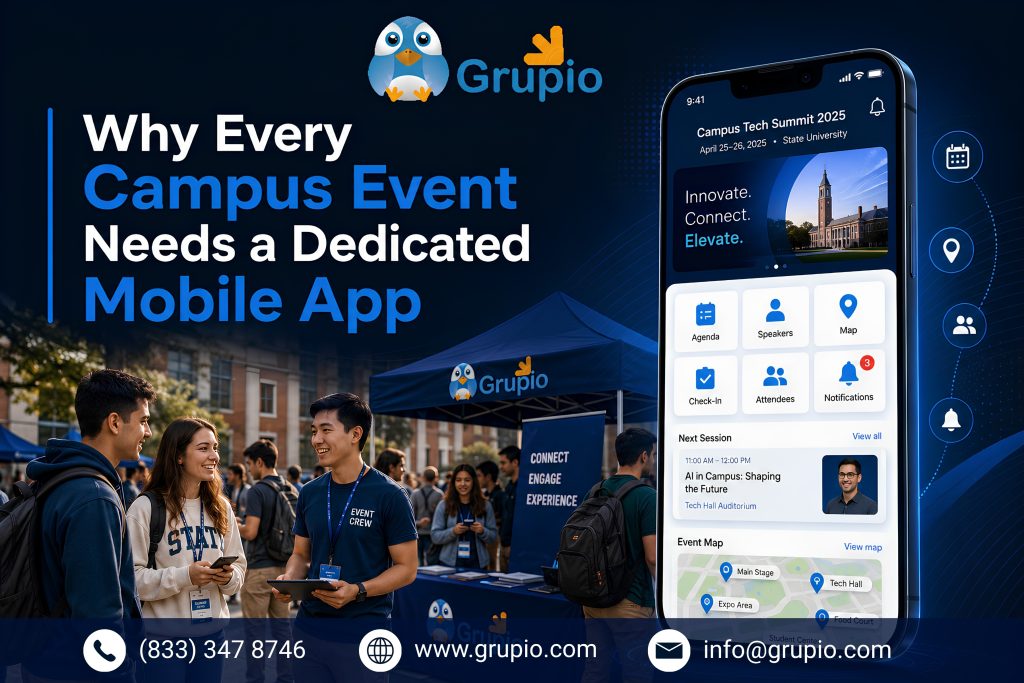
University Event App

Every semester, universities host high-stakes events like orientation week, career fairs, homecoming, commencement, and club recruitment nights. Every semester, the same coordination problems return. Schedules live in one PDF. Room changes are announced through emails that many students never check. Exhibitor and speaker information is often printed in booklets that become outdated by lunchtime.

The status quo isn’t for lack of effort. Event staff and student affairs teams often prepare for months. They build spreadsheets, print signage, and manually update a campus-wide “master schedule.” Even then, students rarely receive those updates in real time. The tools are solid, but paper, email blasts, and static webpages create the bottleneck.

Eventually, a schedule change, weather delay, or packed orientation session exposes the problem. Hundreds of students arrive at the wrong room. An employer may sit at an empty table because the printed map is outdated. That’s usually the moment a university starts looking seriously at a dedicated event app instead of another spreadsheet.

Because of that shift in thinking, campus event technology has moved from “nice to have” to a standard line item in student affairs and career services budgets. According to EDUCAUSE’s ongoing research on student technology expectations, students increasingly expect mobile-first, real-time information from their institutions, not static PDFs. A dedicated app meets that expectation. It provides schedules, maps, notifications, and directories in one place. It is built for how students already use their phones instead of forcing a general campus app to manage high-volume events.

Simplifying Orientation Days with Real-Time Schedules & Notifications
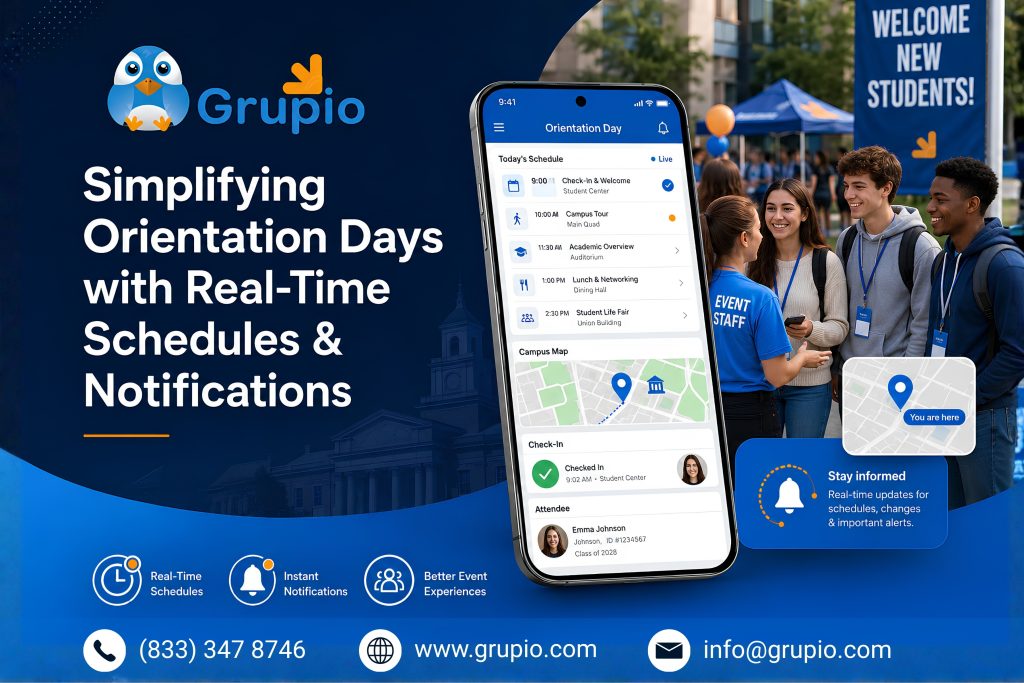
Student Orientation App

Orientation is often the first real test of a campus event app. It compresses an entire semester’s worth of coordination into just two or three days. New students are learning the campus, meeting advisors, and choosing courses. They are also trying to find their next session. At the same time, their families often attend separate activities.

A dedicated app turns that chaos into something navigable. Instead of using a printed booklet, students receive a live, personalized schedule. It updates instantly when a room changes or a session runs longer than expected. Push notifications replace the group text that inevitably gets three replies of “wait, where are we meeting?” And because the schedule lives on the device students already have in their pocket, there’s no “I lost my folder” excuse on day two.

Once that first layer works, the real value appears in the data. Administrators can see which sessions are overcrowded and which are under-attended. They also learn where students spend their time instead of waiting weeks for survey results. That turns orientation from a one-shot event into something a university can actually iterate on year over year.

Boosting Career Fair Success with Interactive Maps & Exhibitor Profiles
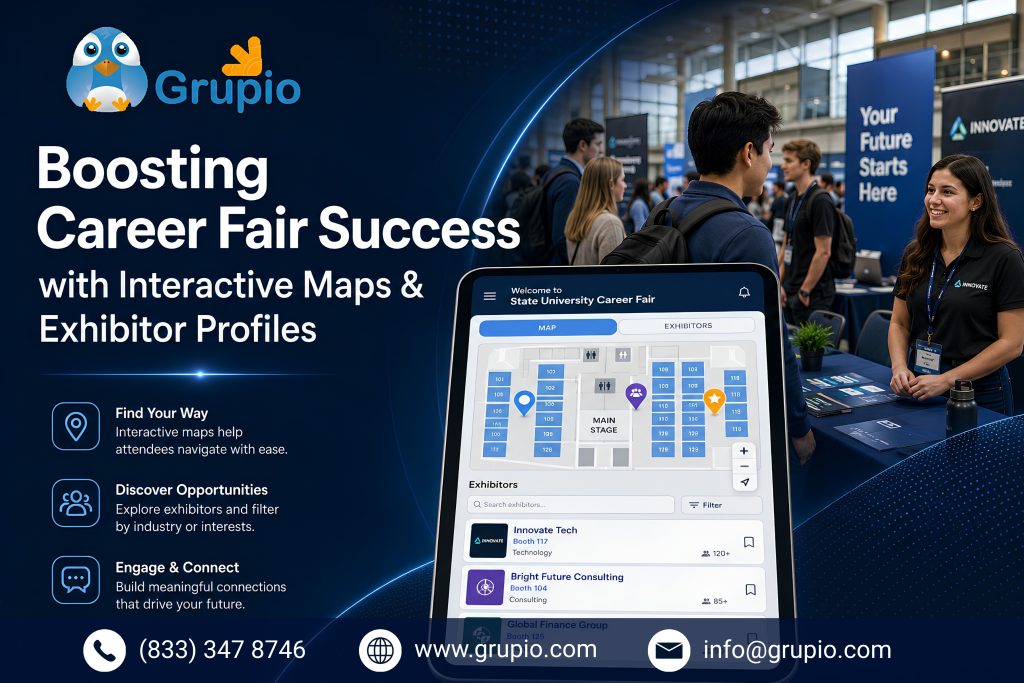
Career Fair App

Career fairs carry a different kind of pressure. Students have a limited window to impress employers. Recruiters are also managing back-to-back conversations. A confusing floor plan can cost a student an important opportunity.

An interactive map inside the event app solves the most basic version of this problem — showing exactly where each employer’s table sits, updated instantly if a company has to relocate. The bigger advantage comes from exhibitor profiles. Students can review company descriptions, open roles, and recruiter bios before the event. They arrive with specific questions instead of a generic introduction.”

Better-prepared students have more meaningful conversations with employers. They are also more likely to receive follow-up interviews. This strengthens career services outcomes and employer relationships. which matters directly to a university’s career services outcomes and, increasingly, to the employer relationships that keep companies coming back year after year. Career fair platforms built specifically for higher education, such as Career Fair Plus, have grown around exactly this need: giving students a searchable employer directory and giving career services teams a way to measure engagement instead of guessing at it from sign-in sheets.

Building Student & Faculty Connections Through In-App Networking
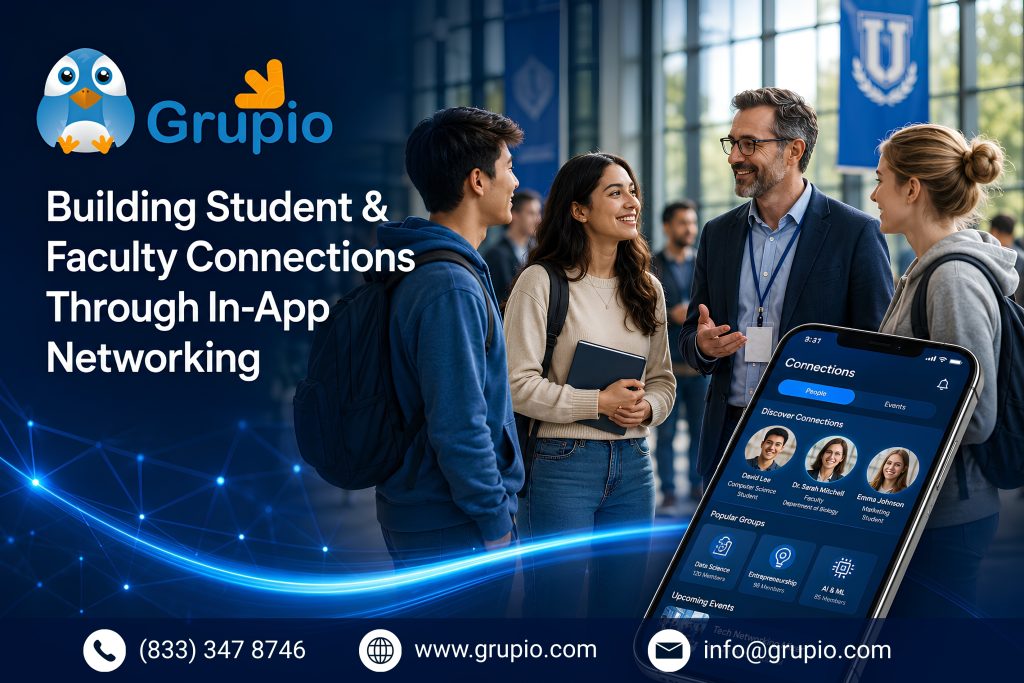
Campus Networking App

Orientation and career fairs are the obvious use cases, but the deeper transformation is what happens between events. A well-built campus app doesn’t disappear once the career fair ends — it becomes a year-round layer of connection between students, faculty, and each other.

In-app directories help students find classmates in the same major. They can RSVP to club meetings or message faculty advisors without searching through old emails or syllabi. Discussion boards and interest groups keep students connected after events. Activities like hackathons, guest lectures, and student mixers give them more reasons to continue using the app.

This ongoing engagement gives universities something that career fairs and orientation alone cannot provide. They gain a reliable communication channel with students. This supports daily campus activities and helps create a stronger sense of belonging.

Branding Your University’s Identity Across Every Student’s Phone
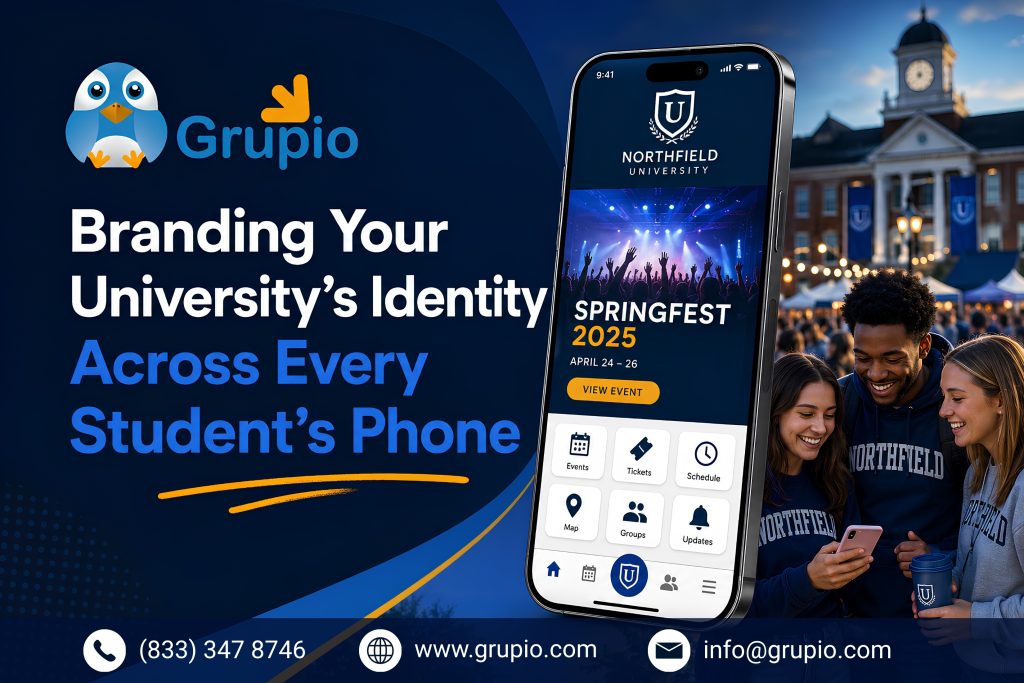
Branded University Event App

There’s a quieter benefit underneath all of this: every time a student opens the app to check an orientation schedule or browse career fair exhibitors, they’re seeing the university’s colors, mascot, and voice — not a generic third-party tool with the school’s logo pasted on top as an afterthought.

A well-designed campus app becomes a consistent brand touchpoint across the entire student lifecycle: the same visual identity from the first orientation notification a freshman receives to the graduation-day schedule a graduating senior checks four years later. That consistency matters more than it might seem — it signals that the university invested in the experience, not just the event.

Over time, what started as a solution for orientation challenges becomes something bigger. The app becomes a trusted, branded home for campus life. Students can find accurate information in one place instead of managing paper, emails, and outdated updates.

Frequently Asked Questions

1. What is a university event app, and how is it different from a general campus app?

A university event app is a mobile tool designed for live event management. It supports orientation, career fairs, homecoming, and commencement with features like live schedules, maps, and exhibitor directories. A general campus app may include event features, but dedicated event apps are usually easier to update and manage during busy events.

2. Do students actually use these apps, or do they default back to email and group chats?

Adoption depends heavily on how the app is rolled out. Apps that are pushed at a mandatory touchpoint — like requiring students to check in via the app at orientation, or requiring an RSVP through it for a career fair session — see far higher usage than apps that are simply “available” in the app store. Real-time notifications (schedule changes, room updates) also drive repeat opens, since students learn quickly that the app has information they can’t get anywhere else.

3. How do career fair apps benefit employers, not just students?

Employers get a built-in audience of pre-qualified candidates who’ve already reviewed their company profile and open roles before walking up to the table, which tends to produce more focused conversations. Many platforms also give employers post-event data — how many students viewed their profile, who they connected with — which helps recruiting teams justify travel and staffing budgets for the next fair.

4. Is it expensive for a university to build or license an event app?

Costs vary widely depending on whether a university licenses an existing higher-ed event platform versus building custom software in-house. Licensing an established platform is generally faster to deploy and lower-risk for a single annual event like a career fair, while a custom-built app makes more sense for institutions that want deep integration with their own student information systems.

5. What data should a university track to measure an event app’s success?

Universities can track useful metrics such as app downloads, active users during the event, session check-ins, booth visits, notification open rates, and survey completion. (which is much easier to collect in-app than via a separate email survey). For career fairs specifically, tracking student-to-employer connections and follow-up interview requests ties the app directly to career services outcomes, not just attendance numbers.

Benefits of Event Management Platforms (And How Grupio Helps You Deliver Better Events)

Why Modern Event Management Platforms Are Essential for Successful Events

Why Modern Event Management Platforms Are Essential for Successful Events

An event management platform is the foundation of successful modern events. Instead of relying on spreadsheets, emails, and disconnected tools, organizers can manage registrations, schedules, attendee engagement, communication, and reporting from one centralized platform. As events continue to evolve across in-person, virtual, and hybrid formats, having the right event management platform is essential for delivering a seamless experience.

Planning an event used to mean juggling spreadsheets, email chains, sticky notes, and a dozen disconnected tools just to keep track of registrations, schedules, and attendee questions. As events have grown more complex—spanning in-person, virtual, and hybrid formats—that old approach simply doesn’t hold up anymore.

This is where an event management platform changes the game. Instead of stitching together separate systems for registration, communication, networking, and reporting, organisers now have access to a single, unified hub that handles it all. A modern event management software solution doesn’t just save time; it directly shapes the attendee experience, the quality of data you walk away with, and the overall success of your event.

Whether you’re running a 50-person workshop or a multi-day international conference, the right platform helps you work smarter, not harder. Below, we’ll walk through the most important benefits of using an all-in-one event platform, and show how Grupio brings these capabilities together to help you plan, run, and grow better events.

The Key Benefits of a Modern Event Management Platform

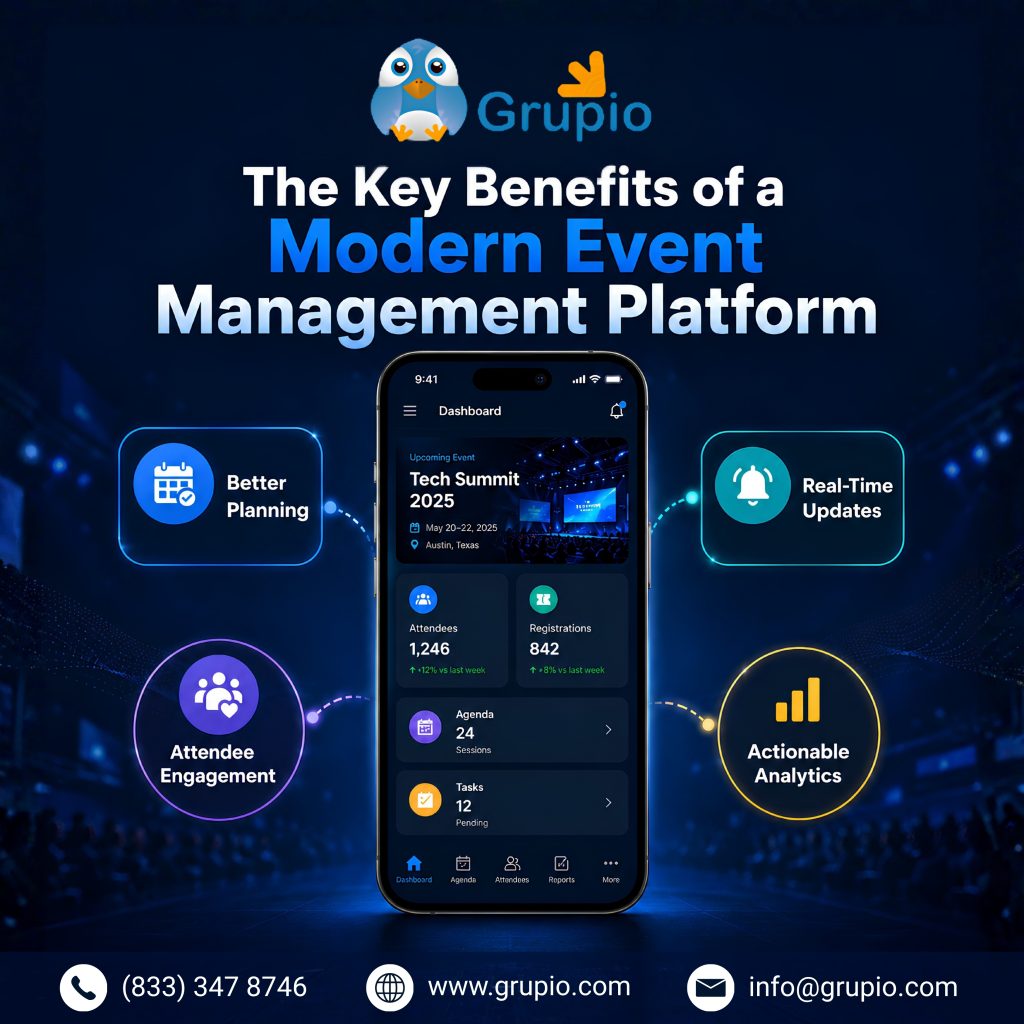
The Key Benefits of a Modern <a href=Event Management Platform” width=”1024″ height=”1024″ class=”alignnone size-large wp-image-6644″ />
1. Centralised Event Management That Eliminates Manual Work

One of the biggest advantages of a true event management platform is centralisation. Rather than managing registration in one tool, attendee communication in another, and session scheduling in a third, everything lives in one place.

This means no more re-entering the same attendee data across multiple systems, no more lost emails buried in someone’s inbox, and no more last-minute scrambling because two team members updated the schedule differently. A centralised system reduces human error, saves countless hours of manual admin work, and gives your entire team a single source of truth.

With Grupio, organisers manage registration, agendas, communications, and attendee data from one dashboard—so your team spends less time on logistics and more time on strategy.

2. Mobile Event Apps That Enhance the Attendee Experience

Attendees expect convenience. A well-designed mobile event app puts the entire event experience in their pocket—schedules, speaker bios, maps, notifications, and more—without the need for printed programs or constant front-desk questions.

A mobile-first experience also makes attendees feel more engaged and informed throughout the event, leading to higher satisfaction and stronger word of mouth afterwards.

Grupio’s mobile app gives attendees a clean, intuitive way to navigate sessions, receive real-time updates, and stay connected to everything happening at your event, from their phone.

3. Real-Time Analytics and Reporting for Smarter Event Decisions

Data is one of the most underused assets in event planning. A capable event management platform captures attendance patterns, session popularity, engagement levels, and feedback in real time, giving organisers the insight needed to make decisions on the fly and improve future events.

Instead of waiting until after the event to assess how things went, real-time reporting lets you adjust on the spot—whether that means moving a session to a bigger room or sending a last-minute reminder to boost turnout.

Grupio provides organisers with live dashboards and post-event reports, turning attendee behaviour into actionable insights you can use immediately and long after the event ends.

4. Seamless Communication Before, During, and After Your Event

Clear communication can make or break the attendee experience. From pre-event reminders to last-minute schedule changes and post-event thank-yous, a strong event app keeps everyone informed without relying on scattered emails or social media posts that easily get missed.

Push notifications, in-app messaging, and automated email sequences ensure attendees never miss critical updates—and that your team doesn’t have to field the same questions over and over.

Grupio’s built-in communication tools let organisers send targeted notifications and updates at every stage of the event lifecycle, keeping attendees informed and engaged from sign-up to follow-up.

5. Personalised Agendas and Session Management

No two attendees want the same experience. Personalised agendas let each person build a schedule around the sessions, workshops, or speakers that matter most to them, rather than navigating a static, one-size-fits-all program.

This kind of flexibility doesn’t just improve satisfaction—it also gives organisers better data on which sessions are in highest demand, which helps with planning future events.

With Grupio, attendees can build their own personalised agendas, bookmark sessions, and get reminders before each one starts, making for a smoother, more relevant event experience.

6. Networking Features That Drive Meaningful Connections

For many attendees, networking is the real reason they show up. A modern event management software platform should make it easy for people to find and connect with the right people, whether that’s through attendee directories, matchmaking algorithms, or in-app messaging.

The easier you make networking, the more value attendees get out of your event, which directly impacts return attendance and referrals.

Grupio includes built-in networking tools that help attendees discover relevant connections, exchange contact details, and start conversations, all without leaving the app.

7. Gamification and Interactive Engagement That Increase Participation

Gamification—think leaderboards, scavenger hunts, polls, and point systems—has become one of the most effective ways to boost participation at events. It turns passive attendees into active participants and creates memorable, shareable moments.

Interactive features like live polls and Q&A also give speakers real-time feedback and keep audiences engaged during sessions, rather than just listening passively.

Grupio offers gamification and interactive features that organisers can customise to align with their event goals, helping drive participation and making the event more fun and memorable for attendees.

8. Hybrid and Virtual Event Support from a Single Platform

The shift toward hybrid and virtual formats isn’t going away. A capable hybrid event management software solution allows organizers to host in-person and remote attendees within a single ecosystem, without needing separate tools or workflows for each format.

This unified approach ensures virtual attendees get just as much value as those in the room—live streaming, virtual networking, and digital session access—all managed from the same backend.

Grupio supports hybrid and virtual events natively, giving organisers the flexibility to reach broader audiences without doubling their workload or budget.

9. Scalable Event Technology for Events of Every Size

Whether you’re hosting a 30-person internal meeting or a 10,000-attendee conference, your event management platform needs to scale with you. Tools that work for small events often buckle under the weight of larger ones, and enterprise tools can be overkill (and overpriced) for smaller gatherings.

Scalability also matters for organisations running multiple events of varying sizes throughout the year, as switching platforms repeatedly creates unnecessary friction and costs.

Grupio is built to scale, supporting everything from intimate meetups to large multi-day conferences, so you never have to outgrow your event technology.

10. Custom Branding That Delivers a Consistent Event Experience

Your event app and registration pages are an extension of your brand. Custom branding—logos, colours, fonts, and messaging—helps create a cohesive, professional experience that reinforces credibility and trust with attendees and sponsors alike.

For sponsored events, the ability to showcase sponsor branding within the platform also adds tangible value that can justify sponsorship investment.

Grupio allows full custom branding across the event app and web portal, ensuring your event looks and feels consistent with your organisation’s identity, and gives sponsors visibility where it matters.

11. Integrations That Keep Your Event Data Connected

An event platform shouldn’t operate in a silo. Integrations with CRM systems, email marketing tools, payment processors, and marketing automation platforms ensure attendee data flows smoothly into the rest of your business operations rather than getting trapped in the event tool.

This connectivity also reduces manual data exports and imports, which are often a source of errors and wasted time for event teams.

Grupio integrates with popular business tools, keeping attendee and event data synced across your existing tech stack without extra manual work.

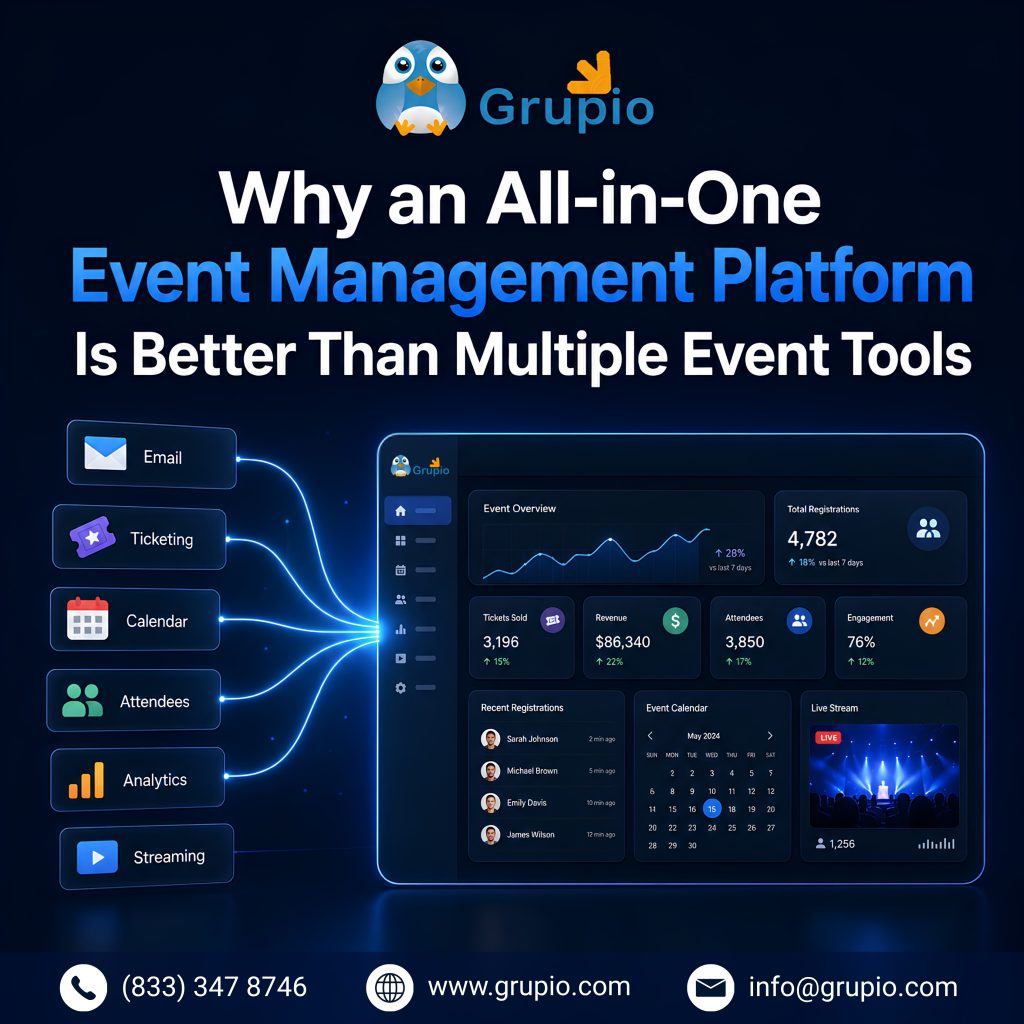
Why an All-in-One Event Management Platform Is Better Than Multiple Event Tools

Why an All-in-One Event Management Platform Is Better Than Multiple Event Tools

It’s tempting to piece together a “best of breed” stack—one tool for registration, another for the mobile app, a third for analytics, and so on. But in practice, this approach often creates more problems than it solves.

Disconnected tools mean disconnected data. Attendee information has to be manually synced (or worse, not synced at all) between systems, increasing the risk of errors and creating blind spots in your reporting. Your team also has to learn and manage multiple platforms, increasing training time and the risk that something falls through the cracks.

An all-in-one event management platform eliminates these pain points by housing registration, communication, mobile apps, analytics, and networking all under one roof. This not only simplifies the day-to-day workload for your team but also gives you a complete, unified view of your attendees and event performance, something that’s nearly impossible to achieve when data is scattered across multiple disconnected tools.

Beyond efficiency, there’s also a cost factor. Paying for and maintaining several separate subscriptions usually ends up more expensive than one consolidated platform, especially once you factor in the time spent managing integrations between tools that were never designed to work together in the first place.

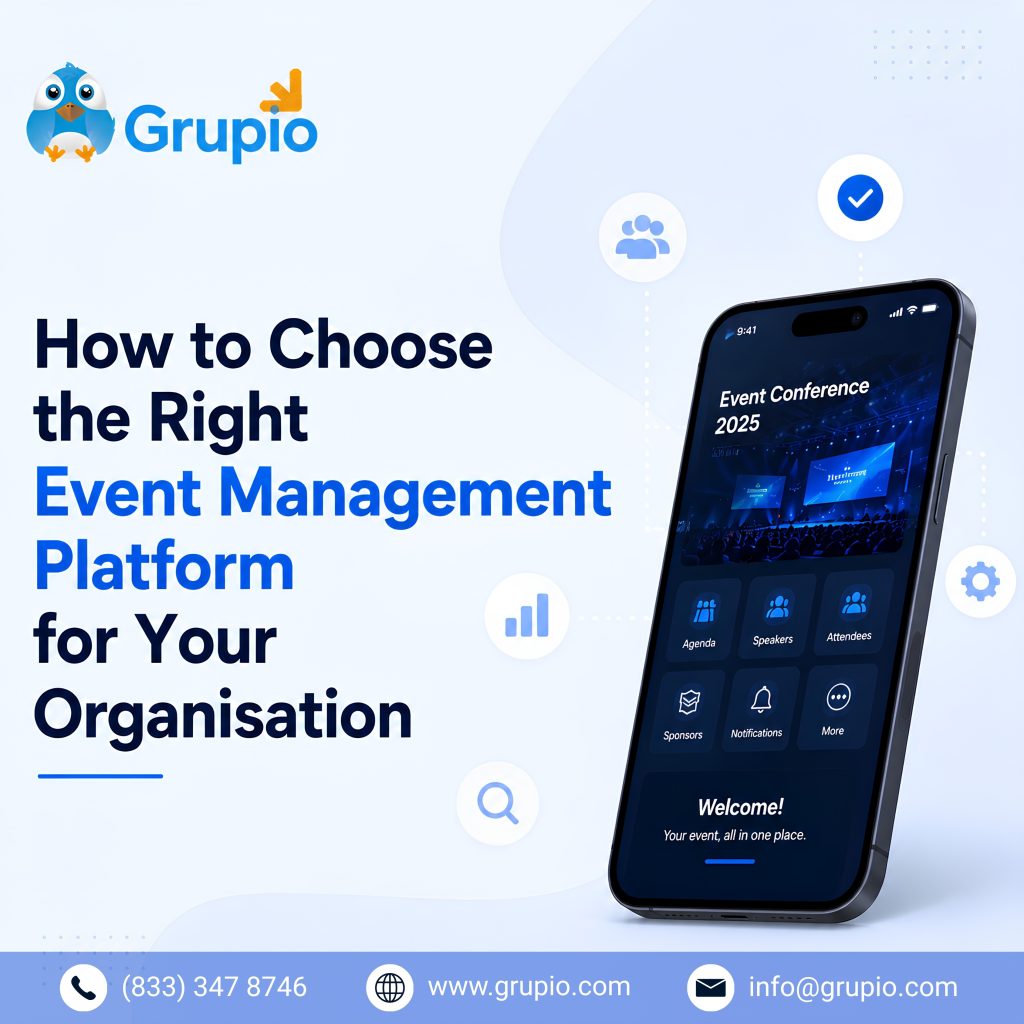
How to Choose the Right Event Management Platform for Your Organisation

How to Choose the Right Event Management Platform for Your Organisation

With so many options on the market, choosing the right event management software comes down to a few key considerations:

  • Event size and type: Make sure the platform can comfortably handle your typical event size and supports in-person, virtual, or hybrid formats as needed.
  • Ease of use: Both your team and your attendees should be able to navigate the platform without a steep learning curve.
  • Customisation and branding: Look for a platform that lets you maintain consistent branding across registration pages and the mobile app.
  • Reporting and analytics: Strong, real-time reporting is essential for making informed decisions before, during, and after your event.
  • Integration capabilities: Check that the platform connects with your existing CRM, email, and payment tools.
  • Support and reliability: Live events don’t pause for technical issues, so responsive customer support is critical.
  • Scalability: Choose a platform that can grow with your organisation, rather than one you’ll need to replace as your events get bigger.

Grupio checks each of these boxes, offering a flexible, scalable, and easy-to-use platform that supports organisations at every stage of their event journey.

Conclusion

Successful events today aren’t built on spreadsheets and scattered tools; they’re built on smart, centralised technology that brings every part of the planning and attendee experience together. From streamlined registration and real-time analytics to mobile apps, networking, and gamification, a modern event management platform gives organizers the tools they need to deliver events attendees actually remember.

Grupio brings all of these benefits into one easy-to-use platform, helping event organisers save time, reduce manual work, and create more engaging, more connected events—whether in-person, virtual, or hybrid. If you’re ready to simplify your event planning and deliver a better experience for your attendees, it’s worth exploring what an all-in-one platform like Grupio can do for your next event.


Leveraging Customer Feedback for Business Events!

Customer feedback carries utmost importance in this arena. Businesses organize different events to learn what customer wants and their expectations from them. But, many of the events get failed due to the unavailability of quality survey tools such as Physical feedback forms or e-forms. Therefore, it is essential for companies to consider some robust solution to leverage customer feedback for their events to make it a success.

Here, we are going to highlight various stages when businesses need customer feedback. To leverage customer feedback during, before and after the event, a corporate event app can prove to be a boon for attendees engagements. Let’s explore various rules for event survey.

  • First Rule – Have Questions With Audience What They Expect Before This Event

When you are planning any event, it is vital to give value to various expectations of the participants. This will help you to present a content of their interest. Usually, most of the event organizers concentrate on their own message rather focusing the need and requirements of the audience. This kind of assumption often brings an event to a stage where it is called “near miss event” besides “a clear hit”. With such event, you won’t facilitate your attendees to come over in future events. So, it is advisable for coordinators to first ask for the audience about their want and then, focus on delivering it.

For this purpose, the ideal way to get thoughts of attendees is to conduct pre-event survey. Use your event planning app, try to research on the needs of your audience and what appeals them. This survey before the event would help you to determine expectations of your attendees and thus, you can plan your event accordingly. For event survey, you may plan few questions like:

    • Preferable time for event – morning, evening or afternoon.
    • Do you want to have a list of confirmed attendees before the date of the event?
    • How far can you travel for this event?
    • Various topics, you are interested in?
    • List out few speakers who you want to see and hear on upcoming events.
  • Second Rule – Audience Engagement During the Event

After organizing giveaways and turning a professional event into a gaming program, it is usually difficult for companies to make audience engaged once the event is proceeding and they get flooded with information or updates relating to your business. At this point, you need to push audience participation by inspiring and growing up their interest into your event.

A boring event is always subjected to be criticized by the attendees. Therefore, it is necessary to think something interesting so that you can add fun and bring audience interest to the event.

For this purpose, you can go for a small survey or a quick audience poll during the event. For survey or poll, you need survey tools like a kiosk or an event App. In this survey, you can enquire about if your audience is enjoying the event or have they faced any issue relating to the topic of the event. This encourages conversation between your company and audience, especially at times when the result of the survey is controversial or unexpected.
Do not forget to share the poll results immediately before further keynote presentation takes place. After getting results, attendees would engage further in your event as their contributing thoughts are involved in it. Use the best event app features to keep your attendees engaged.

  • Third Rule – Post Event Audience Feedback

The feedback from the event audience is one of the most critical steps that helps to assess the ins and outs of an event accurately. Therefore, conduct post event survey  through you conference app for attendee’s feedback on your event, speaker and content. The questions for post-event audience feedback can be as below.

    • From where had, you heard about our event?
    • Rating for event venue
    • Rating on event content
    • Give valuable suggestion or any feedback about this event
    • Rate the performance quality of the speaker
  • Would you like to be a part of our upcoming events?

So, these are few rules for a successful event. The role of audience engagement is great in any event, however, with mobile event app you can, so if you are in search for one then Grupio can help you for this concern.

Grupio is a trusted and renowned name in this industry offering mobile apps for events for more than 2000 events for far in 15 different countries.

Zeena Awan

Zeena Awan is a dynamic Senior Project Manager at Grupio, recognized for her proven ability to lead complex, large-scale projects from inception to successful delivery. With extensive experience in project planning, execution, and process optimization, she excels at streamlining workflows, aligning cross-functional teams, and driving efficiency across operations.

Zeena is highly regarded for her strategic problem-solving skills, strong leadership, and commitment to excellence, consistently ensuring projects are delivered on time and to the highest standards of quality. At Grupio, she plays a pivotal role in enhancing operational processes, fostering collaboration, and implementing scalable solutions that align team performance with organizational goals. Her focus on both client satisfaction and team success has positioned her as a trusted leader in ensuring seamless project outcomes.