
Event Format 101: The One Decision That Can Make or Break Your Entire Event
Every successful event starts with a single, often-overlooked decision: the format. Long before you book a venue, hire a speaker, or design a single slide, you have to decide how people will actually experience your event in person, online, or somewhere in between. Get this choice right, and everything else (budget, marketing, logistics, content) falls into place more easily. Get it wrong, and you’ll spend the rest of your planning timeline fighting an uphill battle.
minutes during a kickoff call rather than the strategic foundation it actually is.
This article breaks down why the format matters so much, and how to choose the one that
fits your goals, audience, and resources.
Understand What Event Format Really Means
Before comparing options, it helps to be clear on what’s actually on the table.
Broadly, event formats fall into three categories:
- In-person events — physical gatherings where attendees share a
single location. Think conferences, trade shows, workshops, galas, and networking mixers. - Virtual events — fully online experiences delivered through webinars,
livestreams, or virtual event platforms, with no physical venue involved. - Hybrid events — a blend of both, where some attendees join in person
while others participate remotely, often through live streaming and interactive digital tools.
Within each category, there’s also a sub-decision about structure: Is it a single
keynote-style session, a multi-track conference, a roundtable discussion, a workshop,
or a networking-first mixer? The format isn’t just “online vs. offline” — it’s the
entire shape of the experience, including pacing, interactivity, and how content gets delivered.
Why Format Matters More Than Most People Think

It’s tempting to treat format as a logistics question — a box to check before moving
on to “the real planning.” In practice, format is a strategic lever that shapes nearly
every other decision you’ll make.
It determines your budget structure. In-person events carry venue,
catering, and travel costs. Virtual events shift spending toward platform fees,
production quality, and digital engagement tools. Hybrid events often require budgeting
for both, plus the added complexity of syncing two experiences.
It shapes attendee experience and energy. Spontaneous hallway
conversations, body language, and shared physical energy are nearly impossible to
replicate online — but virtual formats offer convenience, accessibility, and reach
that physical rooms can’t match.
It influences your reach and inclusivity. A virtual or hybrid format
removes travel and geographic barriers, opening the door to attendees who couldn’t
otherwise participate — whether due to cost, time, disability, or distance.
It affects measurable outcomes. The format changes what you can
realistically track: foot traffic and badge scans at in-person events versus click-through
rates, watch time, and chat engagement online.
In short, the format isn’t a downstream detail — it’s the lens through which every
other planning decision gets filtered.
Key Factors to Weigh Before You Decide
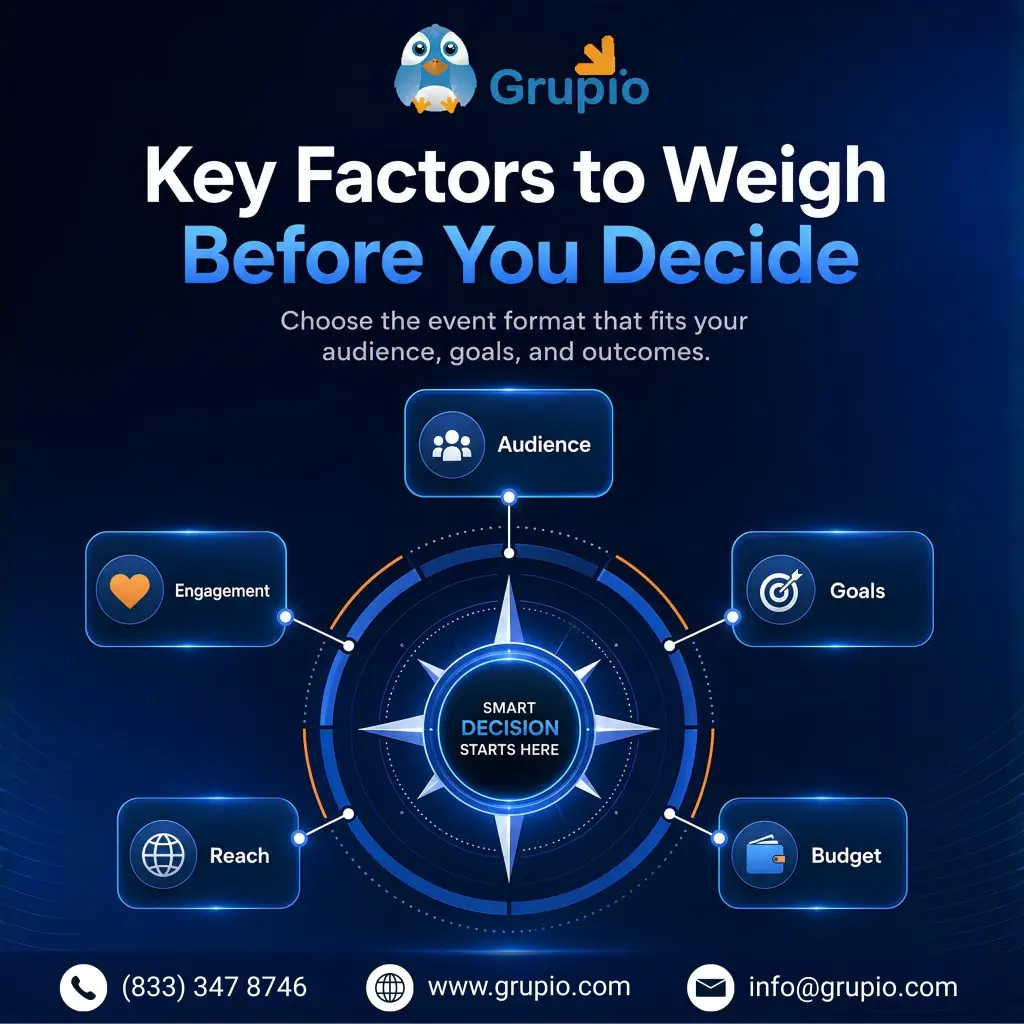
Choosing a format isn’t about picking what’s trendy or what worked for someone else.
It’s about matching the format to your specific situation. Here are the factors that
should drive the decision:
- Your objective. Are you trying to build community, generate leads, educate, sell, or celebrate?
- Your audience. Where are they located? How tech-savvy are they?
- Budget and resources. Be honest about what you can sustain.
- Content type. Interactive workshops often perform better in person.
- Timeline. Virtual events can usually be organized faster than in-person ones.
- Desired outcomes and metrics. Define success before selecting a format.
Running through this list honestly — even briefly — will eliminate at least one format
option before you’ve spent a dollar.
Matching Format to Event Type
Different goals naturally pull toward different formats. Here’s a general guide
(not a rulebook):
| Event Goal | Best-Fit Format | Why |
|---|---|---|
| Building deep relationships or community | In-person | Physical presence builds trust and memorable connection faster. |
| Reaching a large, geographically spread audience | Virtual | Removes travel cost and time barriers. |
| Maximizing both reach and engagement | Hybrid | Combines in-room energy with remote accessibility. |
| Hands-on training or skill-building | In-person | Tactile, supervised practice is hard to replicate online. |
| Thought leadership or educational content | Virtual or Hybrid | Easy to record, repurpose, and scale. |
| High-stakes networking or deal-making | In-person | Informal, unscripted interactions drive outcomes. |
Of course, exceptions exist in every category — a well-designed virtual workshop can
absolutely build community, and a hybrid sales kickoff can drive real deal-making.
Treat this table as a starting hypothesis, not a final answer.
Common Mistakes to Avoid When Choosing a Format
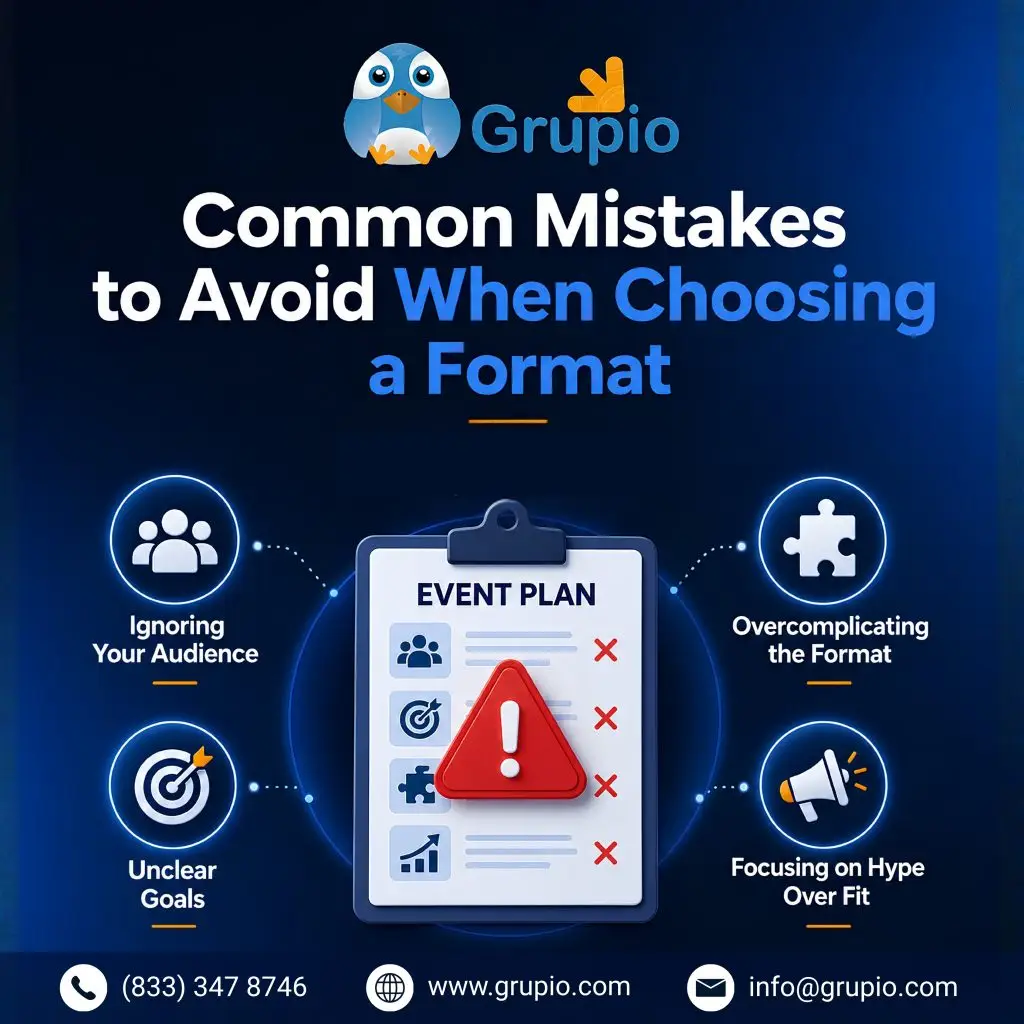
Even experienced organizers fall into predictable traps when locking in a format:
- Choosing based on habit, not strategy. “We’ve always done it this way” is not a reason. Revisit the decision for every event rather than defaulting to last year’s format.
- Underestimating hybrid complexity. Hybrid events aren’t simply “in-person plus a camera.” They require dedicated planning for two simultaneous audiences, separate engagement strategies, and often a bigger production budget than either format alone.
- Ignoring audience preferences. Surveying your audience even informally before locking in a format can prevent low turnout or poor engagement.
- Locking in the format too early.
- Deciding on format before clarifying objectives often leads to a mismatch that’s expensive to correct later.
- Skipping a backup plan. Weather, travel disruptions, and last-minute venue issues can derail in-person events; platform outages can derail virtual ones. Always have a contingency plan regardless of format.
Avoiding these missteps alone can save significant budget and stress down the line.
Conclusion
Choosing the right event format isn’t a box to check off your planning list — it’s the
foundation everything else gets built on. It shapes your budget, your audience’s
experience, your reach, and ultimately whether your event achieves what you set out to do.
Before you book a venue or a platform, take the time to clarify your objectives,
understand your audience, and honestly assess your resources. The format you choose
should serve your goals — not the other way around.
When in doubt, start with the outcome you want, work backwards to the experience that
delivers it, and only then decide whether that experience belongs in a room, online,
or both.
Frequently Asked Questions
1. What’s the biggest factor in choosing an event format?
Your event’s core objective. Whether you’re prioritising relationship-building, broad
reach, education, or sales should guide the format more than budget or trend alone.
2. Is hybrid always the “best of both worlds”?
Not necessarily. Hybrid events can offer the broadest reach, but they also require
more planning, a bigger budget, and dedicated strategies for both in-person and remote
audiences. Done poorly, hybrid can underdeliver for both groups.
3. How do I know if my audience prefers in-person or virtual?
Look at past event data, send a short pre-event survey, or consider practical factors
like geographic spread, travel willingness, and how your audience has engaged with
previous events.
4. Are virtual events cheaper than in-person events?
Often, yes — virtual events typically avoid venue, travel, and catering costs.
However, high-quality virtual events still require investment in production,
platform tools, and engagement features, so costs can add up.
5. Can I change the event format after planning has started?
It’s possible, but costly. Switching formats midway often means renegotiating vendor
contracts, redesigning content, and resetting attendee expectations. It’s far more
efficient to lock in the format early based on clear objectives.