

Most exhibitors lose money at trade shows without realising it. They show up without a system, collect a stack of business cards, hand out swag nobody asked for, and call it a successful three days. Then the leads sit in a Google Sheet for two weeks while the window closes. I’ve watched this happen at IMEX, at Event Tech Live, at every regional B2B expo you can name, and the pattern is almost always the same.
The truth about exhibiting at trade shows is that what happens on the show floor matters less than what happens in the 12 weeks before and the 48 hours after. The event itself is the easy part. The best trade show checklist documents every task, deadline, and follow-up action long before the event doors open.
This piece walks through three phases: pre-event prep, on-floor execution, and post-event follow-up. Each one is a place where I’ve watched good teams quietly leak ROI for years.
Every successful exhibitor follows a structured trade show checklist that covers planning, booth execution, and lead follow-up.
Phase 1 — Set Clear Goals Before Exhibiting at Trade Shows

Pre-event is where most of the ROI is won or lost. By the time you’re loading the truck, the outcome is mostly already decided.
Start With Goals, Not Booth Design
A structured trade show planning process helps teams avoid last-minute decisions and keeps everyone aligned on objectives. The best exhibitors treat trade show planning as an ongoing project rather than a task completed a week before the event.
One mistake I see repeatedly: teams jump straight to booth size, swag, and graphics. Pretty stuff. None of it matters yet.
Trade show planning starts with a single question. What does success at this event actually look like? Pick one primary goal and one secondary. Pipeline generation, deal acceleration, a product launch, or expansion conversations with existing customers. Just two. Teams that walk in trying to do five things end up doing none of them.
Then define how you’ll measure it. Pipeline generated, meetings booked, target accounts visited, demos given. A trade show planning checklist that doesn’t include measurement isn’t a checklist; it’s a wish list. I’ve sat in too many post-event meetings where someone says, “The show went great,” and nobody can point to a number.
Build Your Budget Before You Commit
Many teams use a simple trade show planning template to track costs, deadlines, vendors, and staffing requirements in one place. A reliable trade show planning template makes budgeting discussions much easier.
Trade show costs multiply in ways first-time exhibitors don’t see coming. Booth space and flights feel manageable. Then the exhibitor manual arrives.
Build your full budget across every category from day one: booth space, drayage, electrical, shipping, furniture rental, AV equipment, lead capture app, staff travel and lodging, and marketing campaign costs around the event. Add a 15% contingency buffer because something always comes in higher than you estimated.
Drayage is the line item that catches first-time exhibitors most often. It’s the fee for moving your materials from the venue’s loading dock to your booth, billed by weight, and it’s almost always more than people expect. If you’re exhibiting at trade shows for the first time, ask a peer who’s done the same show what they paid last year. The number will surprise you.
Read the Exhibitor Manual Cover to Cover
Boring, necessary. The manual is where the hard deadlines live. Early-bird electrical pricing, warehouse shipping cutoffs, and freight handling windows. Miss one of those and you’re paying a rush fee, or worse, your booth materials sit in a truck somewhere while you improvise on the show floor.
Go through it once with a highlighter. Pull every deadline into your project calendar and work backwards. That’s your real trade show planning timeline.
A detailed trade show planning timeline also helps prevent missed shipping deadlines, rushed approvals, and unnecessary fees that can quickly inflate event costs.
Build Your Target Account List Eight Weeks Out
Pull names from the attendee list, speaker roster, and sponsor lineup. Split them into three groups: new prospects you want in front of, deals already in motion that need a push, and existing customers who could be ready for an expansion conversation. Each group needs different outreach, different booth treatment, and different follow-up.
Any effective trade show checklist should include target account research as a mandatory step, not an optional activity. Your outreach sequence, booth tactics, meeting goals, and follow-up cadence all get sharper once you know exactly who you’re trying to reach. Trade show coordination across sales, marketing, and customer success starts here, not at the booth.
Start Outreach Six Weeks Out
The goal is to arrive with meetings already scheduled. That doesn’t happen through walk-ins. It happens through a six-touch sequence that starts well before most exhibitors have ordered their swag.
The cadence I run:
- Six weeks out: Introduction email that mentions the event and opens the door to a meeting
- Five weeks out: LinkedIn connection request to build familiarity
- Four weeks out: Value-add email sharing sessions worth attending, paired with a soft nudge to book time
- Three weeks out: Personalised LinkedIn message referencing something specific about their business
- Two weeks out: Calendar link with light urgency on remaining slots
- One week out: Confirmation for booked meetings, last-chance ask for everyone else
Well-prepared pre-event preparation means the show floor becomes the second touchpoint, not the first.
Design Your Trade Show Booth to Start Real Conversations

One of the most overlooked trade show tips for exhibitors is to walk through the attendee journey before finalising booth design decisions.
A booth that looks beautiful from across the hall but starts zero conversations is an expensive backdrop. The point isn’t to win a design award. It’s to design for the interaction you want.
Start with the messaging hierarchy. The largest visible text is your hook. A clear question, a sharp promise, a specific outcome. The second layer is proof of differentiation. Everything else is for people who have already stepped in and are leaning closer.
After a few shows, you realise that booth design and exhibit setup are different problems. The design might look perfect in a render.
Strong exhibit setup planning ensures that furniture, demo stations, and signage work together rather than competing for attention.Then the actual furniture goes in, the counters and demo stations take more visual space than anyone calculated, and your headline copy is suddenly half-blocked. I’ve watched this happen on the show floor with no time to fix it. Mock up the design with the real furniture in place before approving anything.
Tailor your messaging to the room, too. At a niche industry event where everyone already understands the category, lead with what makes you different. At a broader expo where awareness is low, lead with clarity. Make what you do obvious from ten feet away before you try to be clever.
Quick note on swag. Useful beats clever every time. Notebooks, portable chargers, and decent water bottles leave the venue with people. Foam fingers and branded sunglasses end up in the nearest bin. More teams are shifting toward experiences over objects anyway: a quiet VIP lounge, a demo bar, a ten-minute consultation slot. Easier to tie back to the pipeline in the post-event report.
Among the most practical trade show tips for exhibitors is to focus on experiences that encourage conversation rather than giveaways that are forgotten by the end of the day.
Phase 2: Manage Booth Conversations With Clear Intent

Set Up Early and Test Everything
The worst time to discover your lead scanner is broken is twenty minutes before doors open. Get to the venue during setup hours, not at the last minute. Power, Wi-Fi, AV, screens, and lead capture. Run a test scan, sync a test lead to your CRM, and confirm it shows up where it’s supposed to.
Align the Team on the Booth Talk Track
Thirty minutes before the floor opens, run a team huddle. Most exhibitors underestimate the variance in how their own staff describe the product to a stranger.
The talk track I use takes about sixty seconds. Open with a question about their challenge, not your product. Spend the next fifteen seconds qualifying by asking how they’re handling that challenge today. Bridge their answer to a relevant outcome you’ve helped other companies hit. Drop one sentence of proof. Close with a next step booked on the spot, not a “we’ll be in touch.”
The don’ts, while you’re at it: no sitting, no phones, no group huddles at the booth, no leading with a pitch.
Split Your Team Into Anchors and Floaters
Not everyone should be doing the same job on the floor. Anchors stay at the booth running demos and capturing leads. Floaters work the aisle, strike up conversations, and funnel people back. Rotate every three hours. Nobody does their best work after six straight hours of pitching at a standing booth.
Score Every Conversation in Real Time With a Trade Show Lead Capture App
Another one of the most valuable trade show tips for exhibitors is documenting lead quality immediately after each conversation, while details are still fresh.
By 8 PM on day one, every conversation blurs. Score immediately while the context is fresh. A simple 1-to-5 system tied to fit and intent works fine. The point is consistency, not sophistication.
This is where a trade show app earns its keep. Look for one that captures leads, supports lead scoring and rep notes on the spot, and syncs straight to your CRM. Manual badge-photographing-into-a-Google-Sheet is how good leads disappear.
Send Same-Day Follow-Ups to Hot Leads
Before you sleep, send a personalised note to anyone who scored 3 or higher. Reference something specific from the conversation. Deliver on anything you promised. Make the next step easy. Same-day messages keep you on top of the pile while the conversation is still fresh in their head.
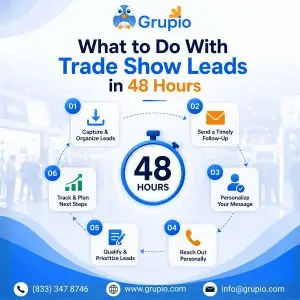
Phase 3: What to Do With Trade Show Leads in 48 Hours
Upload All Leads to Your CRM Within 24 Hours
The most common failure I see is the lead list sitting in a shared Google Sheet for a week while everyone catches up on email. Every hour you wait leads to a cool, context-blur. If your trade show lead capture app syncs directly to CRM, this is mostly already done, which is exactly why that setup matters before you ever get to the show floor.
Assign Every Lead a Dedicated Owner
A lead without an owner is a lead nobody follows up on. Assign based on the conversation that happened, not just on territory rules. A personalised continuation of a real interaction beats a cold handoff every single time.
Follow Up by Lead Score, Not Just Timing
Score 3+ leads get a follow-up within 48 hours. Everyone else within the week. Connect on LinkedIn alongside email. Tailor every message to something the rep actually remembers about the conversation.
Run an Internal Debrief Within Five Days
Get the team together within a week and answer five questions. What worked? What didn’t? Which conversations have the highest pipeline potential? Whether any strong leads came from outside the original target account list. What would you change for the next show? Document the answers. That document is your real exhibitor strategy, refined one event at a time, and it makes every future post-event follow-up faster.
Measure Trade Show ROI Before the Leads Go Cold

The event isn’t over until you’ve measured it. Within 30 days, pull the numbers to determine whether the investment paid off.
Effective trade show planning includes defining ROI metrics before the event starts, not after it ends.
Track these:
- Pre-event meetings booked against your target
- Qualified booth conversations scored 3+
- Percentage of high-scored leads followed up within 48 hours
- Post-event meetings booked from that follow-up
- Pipeline created within 30 days
- Deals accelerated on existing opportunities
Then run two quick math checks. Cost per qualified lead is total spend divided by the number of score-3+ leads. The pipeline-to-cost ratio is pipeline-generated divided by total event spend. A 10x ratio means the event clearly paid for itself. If you’re consistently sitting below that, something in the system needs to change. The target list, the booth experience, the follow-up speed, or, honestly, the event itself. Some shows just aren’t your shows. Industry benchmarks from sources like CEIR can help you sanity-check what “good” looks like for your category.
That’s how trade show ROI stops being a vibe and starts being a number you can defend in a budget meeting.
Frequently Asked Questions
How many meetings should I book before a trade show?
Aim for 15 to 25 qualified meetings on the calendar before you arrive. Pre-booked conversations consistently outperform cold walk-ins, and they give your team something to anchor each day around. If you’re showing up to a major expo with zero pre-booked meetings, you’re starting from behind.
What’s the best way to capture leads at a trade show?
Use a trade show lead capture app that scans badges, supports scoring and notes on the spot, and syncs straight to your CRM. Manual business card collection creates lost context, slow follow-up, and a data entry backlog nobody wants to handle after three days on their feet. The trade show planning template should treat lead capture setup as a hard prerequisite, not an afterthought.
What should be on a first-time exhibitor checklist?
A comprehensive conference exhibitor checklist should also include speaker sessions to attend, networking opportunities, and competitor observations.
Booth setup details, staff briefing on the talk track, lead capture testing, daily debriefs, and a clear 48-hour follow-up plan. Skip the swag-heavy approach until you’ve nailed the fundamentals. A useful conference exhibitor checklist looks almost identical, with extra emphasis on session attendance for prospect overlap.
What is drayage, and why does it matter for trade show budgeting?
Drayage is the fee for moving your materials from the venue loading dock to your booth space. It’s billed by weight, easy to underestimate, and one of the most common budget surprises for first-time exhibitors. Build it into your trade show planning checklist from week one, not week ten.
Booth setup details, staff briefing on the talk track, lead capture testing, daily debriefs, and a clear 48-hour follow-up plan. Skip the swag-heavy approach until you’ve nailed the fundamentals. A useful conference exhibitor checklist looks almost identical, with extra emphasis on session attendance for prospect overlap.
The Trade Shows That Pay Off Are Built on Better Systems
The exhibitors who walk away with real pipelines aren’t the ones with the biggest booths or the flashiest swag. They’re the ones who showed up with a system and worked it through every phase.
Twelve weeks of prep means you arrive with meetings already booked and a booth designed for the conversation you actually want. On-floor discipline means every meaningful interaction is scored and logged before the day is out. The 48-hour sprint after the show is what separates teams who convert booth conversations into pipeline from teams who come home with a stack of cards and good intentions. A well-executed trade show checklist helps teams stay organised before, during, and after the event.
The most successful teams rely on a repeatable trade show planning template and a documented process they can improve after every event. Many of the best trade show tips for exhibitors are surprisingly simple: prepare early, capture lead data correctly, and follow up quickly.
If you’re looking to give your exhibitors better tools for the on-floor part of that system, Grupio builds branded event apps with built-in lead capture, scoring, and CRM sync. Worth a conversation if you’re tired of losing leads to slow follow-up.